
Design around the maintenance workflow
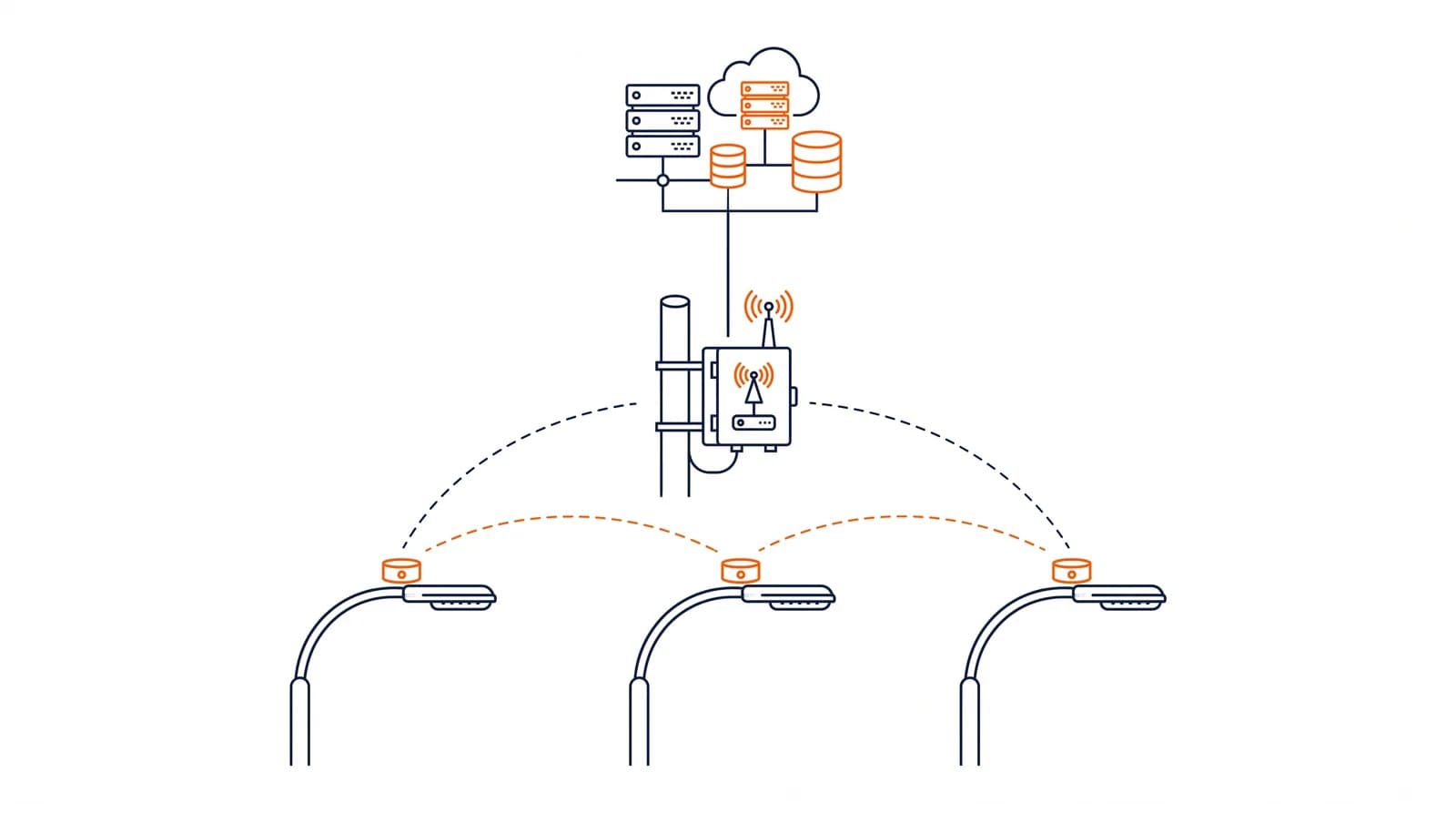
Start with the decisions operators must make at night: which light is affected, whether its driver responds, and who owns the alarm. Three tiers separate local lighting control from backhaul and central operations.
TIER 3  GUANGMANG CLOUD PLATFORM
        GIS · alarms · schedules · REST / MQTT APIs
                         ↕
             Project-selected IP backhaul
                         ↕
TIER 2  NJ-GW01 WI-SUN INDUSTRIAL GATEWAY
        Dual-SIM 4G fallback: confirm gateway variant
                         ↕
              Sub-GHz self-healing mesh
               ↙         ↕         ↘
TIER 1  NJ-iot306W NEMA CONTROLLERS
        Pole A  ↔  Pole B  ↔  Pole C
        Switching · 0–10 V / PWM · telemetry
Redundancy and API services depend on hardware, firmware and integration scope. Validate offline behavior independently of cloud availability.
Specify the controller at the driver interface
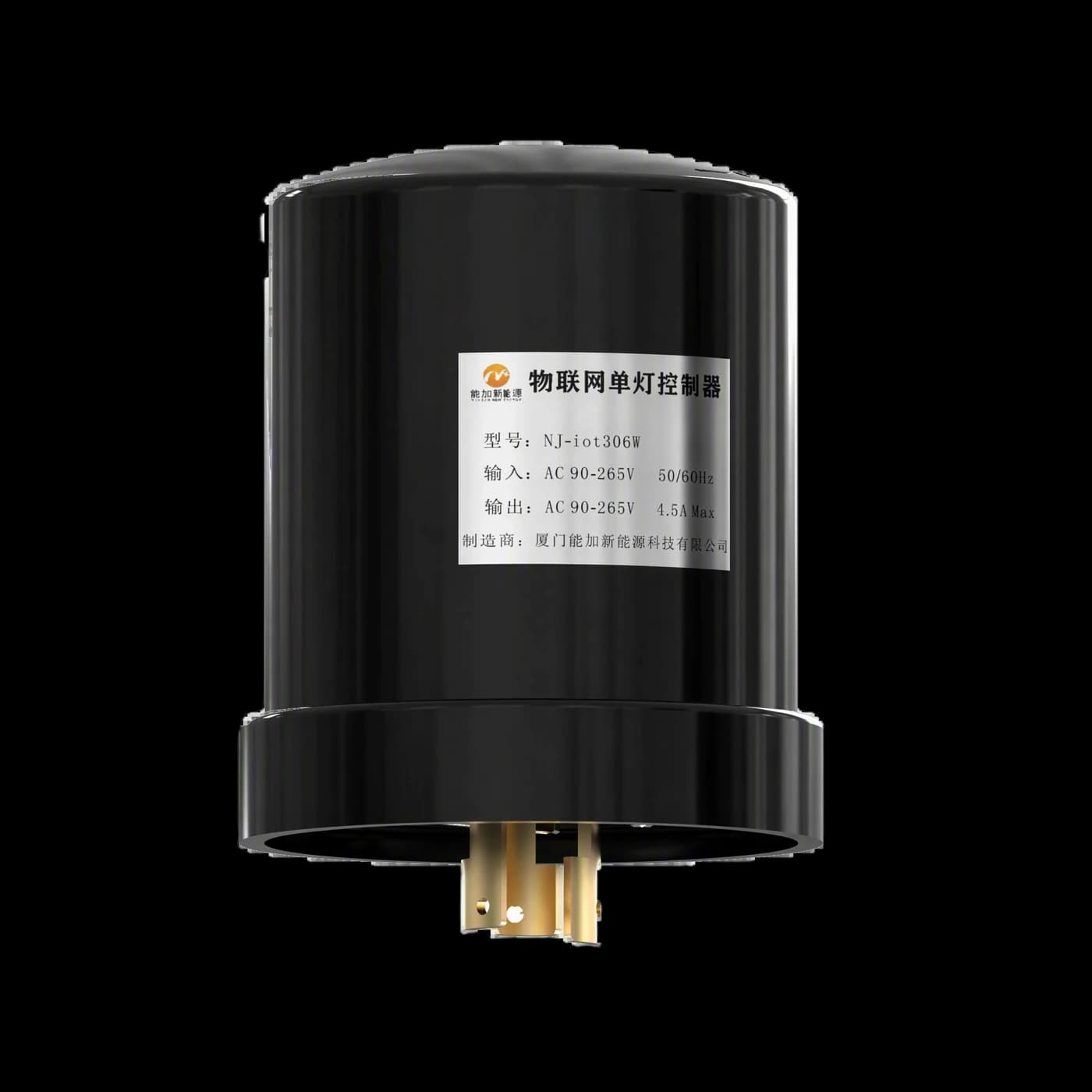
A compatible NEMA connector is only the starting point. Verify electrical load, dimming signals and ordered options together before field commissioning.
| Technical Parameter | Hardware Specification | Field Engineering Benefit |
|---|---|---|
| Supply | AC 90–265 V · 50–60 Hz | Verify site tolerances. A 277 V supply is outside this range. |
| Load | 4.5 A maximum; internal relay rated 10 A | Check driver inrush separately; relay rating is not the continuous load rating. |
| Dimming | 0–100%; 0–10 V and PWM outputs | Match the driver input, signal and wiring before installation. |
| Interface | NEMA 7-pin / 5-pin options | Confirm ordered socket and auxiliary contact assignment. |
| Communication | Wi-SUN · regional Sub-GHz configuration | Select a compatible gateway and locally permitted radio band. |
| Enclosure | IP65 · −35°C to +65°C | Confirm sealing and expected operating environment. |
| No-load consumption | <2 W (controller datasheet) | Include controller consumption in the energy budget. |
| Maintenance | OTA; timed control; scan-based registration | Test commissioning and maintenance workflows in the pilot. |
| Optional customization | Positioning, autonomous operation, tilt/leakage alarms | Specify options in the purchase order rather than assuming they are standard. |
Source: NJ-iot306W datasheet. The supplied introduction states <1 W standby; the datasheet specifies <2 W no-load, used here pending confirmation. Metering-class claims require model-specific evidence.
Open controller datasheet (PDF) ↗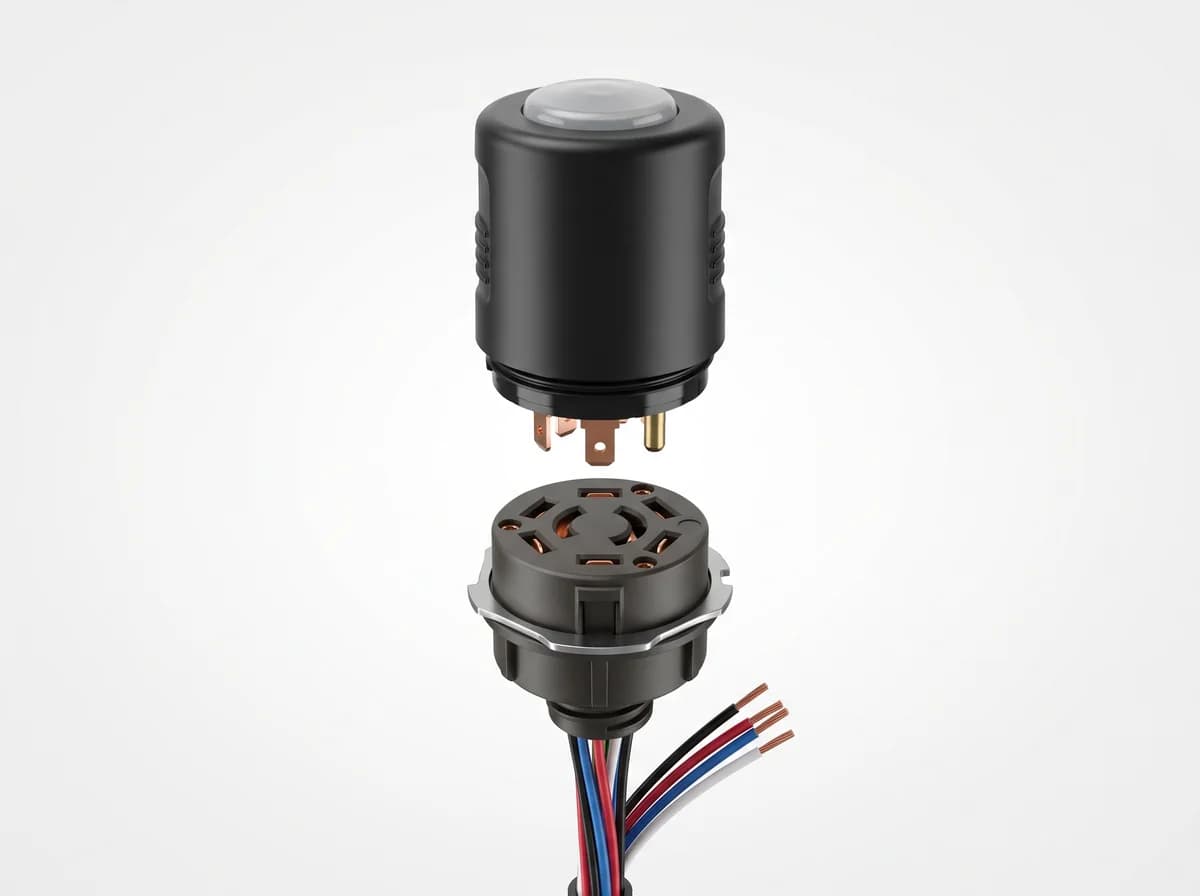
Compare deployment models, not just radio labels
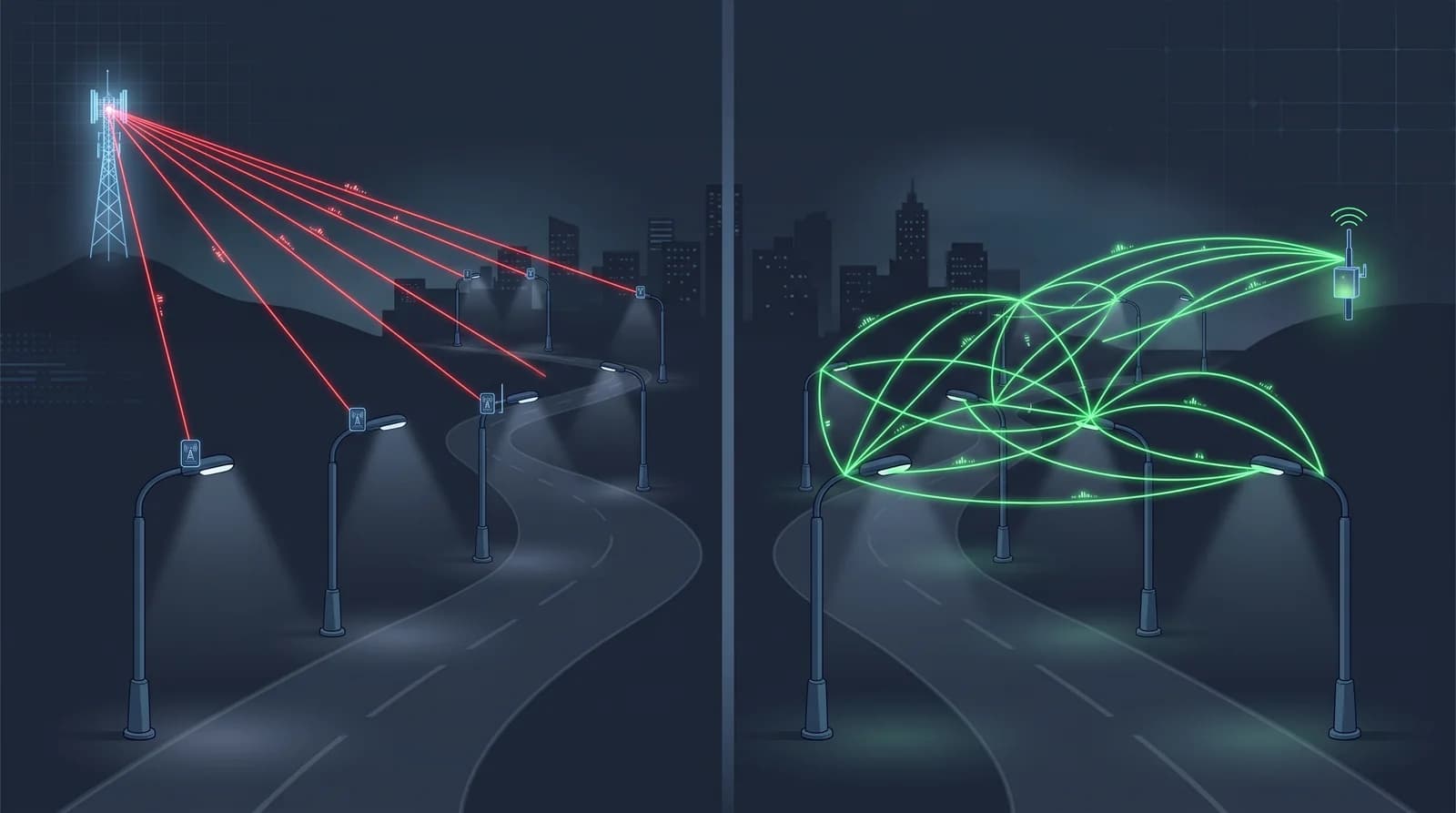
A mesh shares backhaul across a group of lights. Cellular nodes use a carrier network; LoRaWAN uses a star-of-stars architecture. Choose around coverage, command traffic, spectrum and operating ownership.
| Selection factor | Wi-SUN | Cellular NB-IoT | LoRaWAN |
|---|---|---|---|
| Topology | Self-healing mesh; matched gateway | Carrier-managed cellular access | Star-of-stars via gateways |
| Recurring connectivity | Zero per-node SIM fees; gateway data charges may apply | Carrier subscription typically per node | No per-node SIM; gateway, network or service costs may apply |
| Group-command latency | <2 s: acceptance target to validate, not verified product performance | Coverage, carrier and power-saving settings dependent | Device class, downlink windows and airtime dependent |
| Throughput | 50–300 kbps: planning reference requiring PHY/region validation; not a confirmed NJ rating | Carrier and device dependent | Regional data-rate and airtime constraints |
| Validate on site | Mesh paths, hop count, interference and recovery | Carrier coverage and command delivery | Link budget and downlink capacity |
The latency and rate values above are validation references, not guaranteed NJ-iot306W performance. Measure response under the intended node count. PHY rate is not application throughput; routing and retries affect results.
Turn telemetry into an operating process
Guangmang brings asset location, device state, electrical telemetry and alarms into one view. Group control and schedules apply lighting policies; historical curves support fault investigation and consumption review.
Operations
GIS assets, alarm triage, schedules and maintenance ownership.
Integration
Agree REST/MQTT endpoints, authentication, data models and responsibilities.
Field commissioning
Register devices, confirm positions and test commands at the actual fixtures.
Private deployment
Size hosting, databases, backup and retention for the agreed project.
The introduction proposes 16 CPU cores, 32 GB RAM, 2 TB storage and 5 Mbps bandwidth as a private-deployment starting point. Agree final sizing, supported Linux versions, security updates and licensing for the actual scope.
Close seven decisions before the RFP
Turn the architecture into an acceptance scope with this working checklist.
0 of 7 reviewed · selections apply to this visit
Evaluating Wi-SUN Mesh for Your Next Lighting Project?
Share your site layout, fixture quantity and driver requirements. Discuss controller configuration, gateway planning and evaluation scope with NetJoin.